Author Name: Muhammad Asimuddin
From the last 14 years, I have worked across different industries on Microsoft Dynamics 365 CRM and later on the Power Platform. One thing I clearly remember, especially from banking, not-for-profit and similar environments, is how heavily organizations rely on case management.
It is one of the strongest capabilities of Microsoft Dynamics 365 Customer Service and, in many ways, a key reason why D365 stands out in the CRM space. While platforms like Salesforce and HubSpot have evolved strongly around sales, Microsoft has always been very strong when it comes to capturing and managing information through customer service.
But there is something missing.
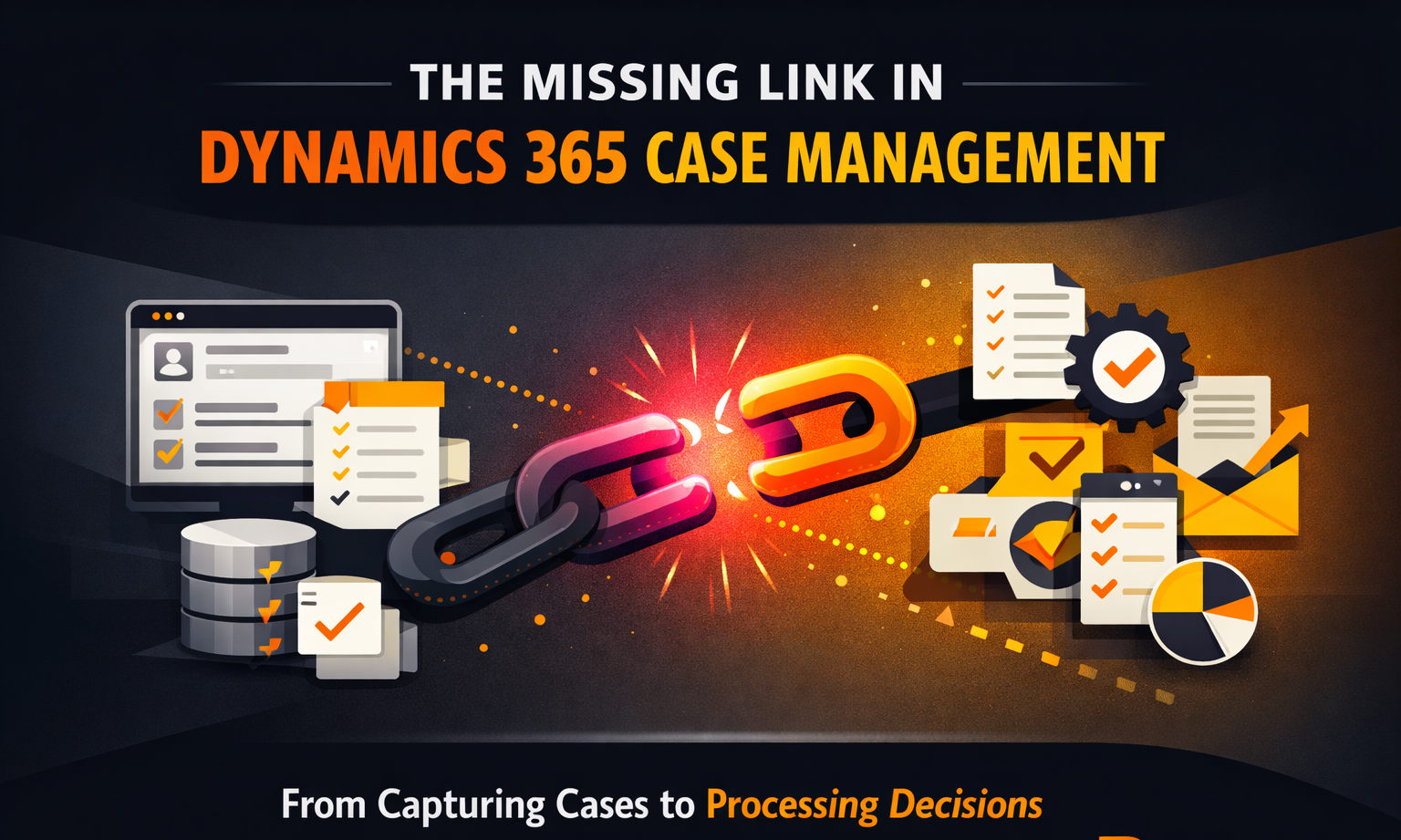
Over the years, I have seen that businesses do not just need a system to capture data. They need a system that can take that data from one stage to another and help them process it into a decision. Traditionally, this processing has always happened outside the system, even though the case itself is tracked inside it.
Now, with the rise of AI and increasing expectations from businesses, this gap is becoming more visible than ever.
Microsoft Dynamics 365 Customer Service is excellent at capturing and managing cases. It helps organizations track interactions, manage SLAs, and keep everything in one place. But when you start using it in real scenarios, one thing becomes very clear.
It captures data very well, but it does not process it.
In many industries, a case is not just something to track. It is something to evaluate and decide. Think about university admissions, certification bodies, government assessments, or insurance. The case is only the starting point. The real work is in assessing the data and reaching a decision.
What usually happens today is quite fragmented. Data is captured in Microsoft Dynamics 365 Customer Service, but the actual evaluation happens outside the system. Teams move to Excel, emails, or other tools to review and score. Once the decision is made, it is updated back into the system manually. This creates delays, inconsistencies, and makes it difficult to maintain proper audit trails.
The platform behind it, Dynamics365 & Dataverse, is very capable. It handles data, security, and automation extremely well. But it does not provide a structured way to run assessments with scoring, rules, and decision logic. That part is still missing.
At the same time, expectations from systems have changed. Businesses want faster decisions, more transparency, and better control. They also want to leverage AI, but that only works when your decision process is inside the system, not sitting in spreadsheets or emails.
This is where the shift is happening. It is no longer just about managing cases. It is about turning your system into a place where data is captured, processed, and converted into decisions.
At Datanox, we saw this gap early. That is why we built Intelli Assessment on Power Platform. It extends Dynamics 365 from just case management into a decision platform. You can define criteria, apply scoring, capture evaluations, and generate outcomes, all inside Dataverse.
You can explore it here
https://datanox.io/intelli-assessment/
The idea is simple. Do not just capture cases. Process them where your data already lives.
If your current setup is still relying on external tools for evaluation, then you are only using part of what Dynamics 365 can actually do. The real value comes when your data, process, and decisions sit in one connected system.
Submit the form to access the white pager.
Submit the form to access the white pager.
Submit the form to access the white pager.